Recent
Questions & Topics of Discussion
The Pond Report
offers pond information on a variety of subjects and we recieve many
questions from people who need more information or who need expert
advice. Please use our website to find the answers to your questions
about pond and pond tips for keeping a healthy pond. Please understand
that due to volume of requests for help we may be forced to charge
a fee for our services in the case of large projects or in-depth proposals.
Send your Questions to The Pond Report Email
us for information or with your questions.
Questions
& Answers Page
Question:
Long Term Pond Care Program
Hi ThePondReport.com
, thank you very much for your words. If the bacteria works also
in a septic, is there a difference between the bacteria used in
septics and the bacteria used in ponds? Also, I see on your site
that you offer a pond consultation for $100. I'm desparately trying
to find a long term care program that provides a solution to majority
of algae and so on. I'm feeling that the combination of bacteria,
aerator, dye and possibly tripoid grass carp could be a solution.
Would you recommend the consultation? Best, Jason
Answer:
Long Term Pond Care Program
Hello i Jason, There is a difference in the blends of bacteria that
are used in septics and in ponds. There are specific blends that
work on various problems; some bacteria works on grease, some on
organic waste and some on hydro-carbons and compost leachates. It
is best to use a bacteria designed for a specific situation. Some
bacteria that is used for septic fields and septic tanks may provide
benefits to a pond but it is a bit like taking a headache medication
when you have a sore back...there might be some benefits but it
is best to use the right analgesic for the job!
If you are looking for a long term strategy I can probably help,
and while I do feel that our consultation services can be beneficial
we are moving towards offering our advice for free and then recommending
products that we feel will help. We do make a small profit on the
products we sell thanks to help from manufacturers and in this way
we can offer help to pond owners like yourself and if you appreciate
the knowledge and help we give you can purchase the recommended
products from us to show your appreciation. We find this works well
with our goal of helping people as we would often do a $100 consultation
and people would not be satisfied...so we needed to find a better
way to help without asking for a consultation fee.
We now do our consultations on a "pay what you want" system. We
provide as much information to a pond owner as we can and if they
want to show their gratitude they can send a payment to us from
a secure Paypal/Credit Card payment link we send. I will briefly
give you a summary of what you should do for a long term pond care
program.
1. If you have
a natural Earth Pond, that is a pond with no liner, ensure your
pond has proper growth around the edges and shoreline. You need
to keep a buffer zone of vegetation growth of at least 3 feet to
resist erosion and prevent runoff from entering the pond. This helps
reduce the nutrients that cause algae from entering the pond.
2. Circulation/aeration. You must have water movement and aeration
to support fish and keep the waters clean. Oxygen is one of the
basic principal ingredients of a healthy pond. Bottom mounted, often
called "lake bed aeration" is very efficient. Fountains and surface
aerators can also help circulate and add vital oxygen to the pond.
Waterfalls can help but they provide mostly circulation benefits
and while they do offer some aeration it is not as efficient as
other methods.
3. Aquatic vegetation. Adding aquatic plants and shallow shoreline
dwelling species will add oxygen naturally to the pond and will
help filter out nitrates and nitrites while providing beauty and
shade to the pond. In ponds that are exposed to open sunlight the
warmth of the sun can lead to algae blooms and steps should be taken,
if no natural springs are feeding the pond, to reduce the sun's
effects on the pond.
4. Beneficial bacteria. Organic material will accumulate on the
bottom of the pond and this build-up will create conditions ideal
for algae growth. Using a natural bacteria will help reduce this
tendancy. Many bacterial mixtures, including the one we recommend
and sell, contains barley straw which is a natural algaecide. This
algaecide, combined with the bacteria that consumes muck and nutrients
will help keep the pond water clear and reduce the growth of algae.
5. Algaecides. Any algaecide like Polydex, Copper-Sulphate, or other
such products should be used with care as they can be harmful to
certain organisms and have certain restrictions for usage. On our
algaecide and bacteria page we have listed a good algaecide but
even that should be used only in extreme cases. It is better to
use natural plants, aeration and harmless bacteria to maintain a
youthful pond but in certain cases where there is no choice but
to rapidly eliminate algae we do recommend and sell certain safe
algaecides.
6. Dyes and Floating Islands. Aquatic dyes and liquid shade can
be helpful to slow or stop weed growth and algae proliferation.
They work by blocking sunlight from reaching the depths of the pond
where the rays would normally heat the pond bottom and release phosphorous
and other elements like ammonia and nitrates which cause water problems.
Floating islands can also be used to provide shade but these natural
water filters can be expensive and while they do provide benefits
such as filtration via plant roots to a pond the aquatic dyes are
something more affordable that can be added every month to a pond
to reduce the sunlight that hits the pond floor.
7. Triploid grass carp. Grass carp have proven to be effective in
controlling a large number of different aquatic weeds, including
Chara (stonewort), water plantain, sago pondweed, Canada waterweed,
and filamentous algae. The young growth of pond cattails, sedges
and rushes may be eaten and ultimately controlled, over time, as
older plants die back. Adding the triploid grass carp into ponds
and waterways is not legal in all districts and municipalities so
it is best to verify with your local Environmental Agency if adding
the triploid grass carp is allowed or rewquires permits. Certain
algaecides, like Polydex, can cause the toxic accumulation of toxic
copper in the organs of these fish which is why we only use non-copper
based algaecides in our projects. These are fundamental issues we
look at in any pond especially when it is plagued with algae.
Don't forget, Jason, that what gets washed into your pond can also
have a major impact on how the water reacts and how much algae you
have. I have seen people living 3 miles from a ranch and they were
constantly having huge thick matts of algae growing every time it
rained. It was from the rich nutrients in the horse manure being
washed into the pond that caused the problem...cows, goats and duck
manure can cause the same reaction. I think that the combination
of bacteria, aerator, dye and possibly triploid grass carp could
be a very good solution.
I hope this information helps you. I can go further if you would
like a full consultation. For the $100 consultaion we will look
at diagrams and photos of the pond and help create the best plan
for a longterm sustainable plan for your pond. If this information
has been enough you can also show your appreciation by offering
a small payment based on what you feel my help has been worth.
Questions
& Answers Page
Question:
Planning 1/2 Acre Pond
Hello! I am digging a 1/2 acre pond and wondering about the placement.
What is a good distance from home? What is a good depth for the
pond and how much can I plan on spending for chemicals, an aerator
and the excavation?
Answer:
Planning 1/2 Acre Pond
Hi! When I was working for a pond supply and construction firm we
did it all; from planning to construction and then supplying aeration
etc. First of all, from what I've seen over the last 12 years, you
should expect to follow a few steps: Contact a few local pond builders
and ask for some pricing. We always told our clients that a finished
pond would cost in the area of $1 per square foot...since a 1/2
acre pond is about 22,000 square feet we would often ballpary $22,000.
Of course this depends on terrain and a good contractor will do
a soil sample.
The depth you want to dig depends on if you are having fish, if
you have natural springs feeding the pond, and if you are in good
clay or soft sand and need a liner. As I've said before a pond that
is natural will want to maintain a 2 to 1 slope so no matter if
your contractor says he can dig a 30 foot pond that is 50 feet in
diameter it will soon be only 15 feet deep based on the natural
laws of physics.
Of course we
did incredible landscaping and made the pond look like a totally
natural pond with rock features, lovely embellished banks and natiral
plants along the shoreline. Many contractors will quote low and
dig you a hole that will turn into a muddy mess. Be careful and
ask for references! Your pond, once built, might look rather poor
for a couple of years until the vegetaion takes hold and depending
on many conditions that we often consulted on. Aeration in a 1/2
acre pond should cost no more than $2000 and is usually not less
than $800. Again...it depends on who you ask. It is best to ask
an established firm as we've seen the internet clouded with many
so-called experts! For chemicals...if you build the right pond you
won't need any! Perhaps a natural bacteria would help but chemicals
can lead to a dependance and even more problems. A pond is a living
eco-system and should be treated differently than a swimming pool!
I've worked on many ponds and suggest you do your homework and ask
an expert before giving anyone the mandate to "Dig In!" Have fun!
Question:
Horrible Algae in Small Pond
HEAVY TYPE ON TOP OF POND . THE FEW GRASS CARP DO NOT SEEM TO EAT
IT . HOPE YOU HAVE ALGAE KILLER WHICH WILL NOT KILL THE FISH . MATTHEWS
, NC 28105 Do you have what I need by order or access in or near
Matthews , Monroe or Charlotte , NC ? Respectfully ,
Answer:
Horrible Algae in Small Pond
Hello
and Thanks for writing! Getting rid of the algae isn't too difficult.
We don't use chemicals like copper products as this can create a
cycle where the algae dies and then sinks and then decomposes and
this causes more algae to grow and then you have to add more chemicals!
This is a waste of money and can also damage your fish. We like
to use natural bacteria products that are not chemicals but concentrated
natural bacteria that consume organic materials in the water...this
reduces algae and over time your pond won't be affected with algae.
Always make sure you have good circulation or aeration as this helps
too. I would recommend two products for your pond, you can buy them
on our secure online store, and we can ship them directly to you
in North Carolina.
Top-rated
algaecides and totally natural pond bacteria
To remove horrible thick algae on a small pond over 1/2 an acre
to 2 acres use:
EPA Registered - CleanGreen Pro7
Rating (Our Highest) (50 lb bag)
Green Clean, with out Pro7 rating, is an alternative to algaecides
that utilize either copper or synthetic chemicals as their active
ingredients.
CG Pro7 is a gra nular product that attacks planktonic and filamentous
algae on contact. Through the power of oxidation, the treated algae
die within hours of being treated. For spot treatments apply at
a rate of 20-50 lbs/acre-foot. For algae blooms apply at a rate
of 9-30 lbs/acre-foot.
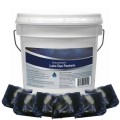
Natural ENV - Ponds Keeper Bacteria7 (25 lb pail)
Each pail contains 50 soluble pouches of 1/2 pound each of high
potency natural, safe, bacteria for ponds. Breaks down organic sludge
like leaves, dead plants, fish droppings, fish food, fertilizer
and dead algae. Reduces odors. Harm less t o fish, animals and turf
plants. Apply 6-8 packets (3 to 4 pounds) every 2-4 weeks. **IMPORTANT
: Do Not Begin Treatment with Ponds Keeper Bacteria7 within 72 hours
of treatment with CleanGreen Pro7
Contact us for special Pond Report bricing to buy natural algaecides
and beneficial bacteria for your large pond. |
algaecides
and pond bacteria |
For Ponds smaller than 1/4 with Horrible Algae Use - UltraClear
SST:
Dosage Instructions: The dosage of UltraClear SST is based on the
volume of water in pond. Generally, use 1 ounce for every 150 gallons
of pond water. The required frequency of product dosing will vary
between once per week to once per month in most cases. If you are
simply trying to prevent a problem that seems to occur each year,
start dosing UltraClear SST before you have a problem, and repeat
once a month during those months when you have normally experienced
blooms.or growth in your pond. If you are treating an existing problem,
dose once a week until the problem is solved, then revert to dosing
monthly or as needed.
This should be combined with an activated barley straw mixture to
balance the ph and create conditions that inhibit algae growth.
With the UltraClear SST you will add the following :
2 - Barley Straw and Peat Extract Liquid
Microbe-lift Barley Straw and Peat extract will give you all the
benefits of concentrated barley extract plus the added benefit of
liquid peat to help maintain an ideal pH in Alkaline ponds. Rich
in organic peat which softens pond water reducing nitrate and phosphate
concentrations in the water column and provides a natural buffering
agent and ion attenuation in lined ponds that additionally gives
them some beneficial properties of earthen ponds.
The combination of these two products, combined with proper circulation
or aeration through a fountain will get rid of that pesy algae.
The dosage information can be adjusted as you achieve the desired
results. Most clients prefer to buy a few of each product as they
have a long shelf life. Best Regards, The Pond Report
Questions
& Answers Page
Question:
De-icing Bubbler for Duck Hunting
I was wondering
how i could get power to my bubbler or pump that i want to get if
i can get power to it, it is a lake that i use for duck hunthing
in the middle of a field with no power anywhere i was wondering
if their was anyway of getting power to it without spending lots
of money.
Answer: De-icing
Bubbler for Duck Hunting
The easiest way would be to operate your bubbler using an electric
generator. We've helped design many bubblers for hunters who want
to keep ice off of ponds and lakes for duck hunting. A bubbler,
using some sort of diffuser tubing or PVC pipe with holes in it
can be placed in the pond and a rotary vane compressor or a regenerative
blower can be kept in the hunt shack and be fired up by using a
portable generator to generate electricity. It will take a few hours
to melt through the ice if it is very cold but soon the open waters
will form over the diffuser tubing and the ducks will have open
water to land. We work with many duck hunters who need to keep ice
off the pond and the portable genrator is the best option. We sell
an exclusive gasoline generators that feature smooth, easy starting,
fuel-efficient. four-stroke, overhead valve engines. They are, we
consider, to be equal to the Honda OHV line of generators at much
less of a cost. These electic generators have a 10 hour run time
per tank which is suitable for duck hunting bubbler applications.
Our smallest unit is a 2,300 Watts generator with 2 outlets (110/120
Volts) that only weighs 100 pounds and has a 67 decibel noise level
at 25 feet. These electric generators, perfect for duck hunters
and duck lake deicers, ranges from $480-$925 depending on the generator
required, we carry generators for up to 6,000 watts. These are also
great for emergency power supply in disasters.
Question:
De-icing Docks and Boat Houses
I have a couple questions: I have 2 bubblers from WDA Products in
Keswick, Ontario. I need new propellers for them and WDA doesn't
seem to be in business. Any idea where I can get props? Is it recommended
to put the bubblers in before the ice or can you drill a hole in
the ice and put them in before the ice breaks up 3- I have a boathouse
and a couple of docks. Width wise it covers about 80 feet across
and they come out about 30 feet. Will one bubbler do? There's 8
feet of water at the end of the docks/boathouse and 1-2 feet at
the shore.
Answer: De-icing Docks and Boat Houses
I'm not sure if WDA Products in Keswick, Ontario is even open anymore.
It's been a while since we've had any information from them. Try
contacting a Kasco dealer in your area, they have props that may
fit. Or maybe consider a new unit ( a 1/2 HP unit can be found for
less than $550) Most people put the de-icer in before the freeze
but you can cut a hole in the ice and insert the de-icer (properly
mooring the device of course) and it will quickly open a huge hole
in the ice. With an 8 foot depth I would use a single 1/2 HP de-icer
as a best price option. The de-icer with the thermostat control
would be less than $650. Search for a Kasco
Marine Dealer in Canada in our search box at the top
of this webpage.
Question: Building a Direct Solar Aeration
System
I much enjoyed your paper on solare
aeration. I am in the process of trying to put together
a direct system myself. You refere to the "Thomas line of solar
pumps". I have searched online for these, but haven't found anything
exactly like that. Are you refering to the DC mini air compressors
the Thomas pump manufactures? If so, are there particular models
which are more appropriate for the solar aeration use. I have seen
the Thomas 5010 which is rated at .134 CFM and 280 mA. That seems
a little on the small size. I have also seen the Thomas model 107CDC/C20
which is rated at 1.4 CFM, but 7amps which seems like a lot for
a direct solar system. Any thoughts or information would be greatly
appreciated. I have found what you said in your paper to be true
concerning the problem of finding dealers with the know how to help
put such a system together.
Answer: Building a Direct Solar Aeration
System
The Thomas pumps were the DC pumps of choice we used in our custom
DC (solar) aeration systems. We found them to be rather weak as
far as CFM and thus often recommended windmills instead of solar
direct systems but there are some high CFM pumps available. Our
PRDC001 will give you approx 1 CFM at 8 PSI and the PRDC002 will
give you approx 2.5 CFM at 8 PSI. We use these extensively for solar
DC powered aeration projects. These pumps are the best we've used.
We use a 12V American-made, oiless compressors that provide high
volume at low pressure (10 psi max). Our small unit runs over 6
hours on a standard car battery; the larger pump is a little more
demanding. Our compressors come with 9" pigtail wire, two feet of
3/8" ID outlet hose and inlet filters. Warranty is one year. Shipping
is extra. PRDC001 - Small 12V DC pump (9 pounds ship weight) - $377
plus shipping PRDC002 - Large 12V DC pump (15 pounds ship weight)
- $778 plus shipping I share your frustration at finding qualified
local solar aeration dealers and if I can help in any way please
let me know. If you would like to order our pumps let me know and
I can arrange shipping within a few days. See
our reviews of Battery Operated Air Compressors for Pond Aeration
Question: Toy Windmills
I'm taking four 13-yr-olds to the beach for a few days
and I wanted to find a simple windmill that powers a water pump
that is small and simple enough that, with the addition of pvc pipes
split in half lenghtwise, the kids could build a way for the wind
to pump water into a construction of their own, which would route
the water to their sand castle's moats, ponds, waterways. So this
should be small and light, and easily fix-able after the crashing
surf occasionally dis-assembles it. Any ideas? I'm about to build
it myself but wondered if anything like this could be bought more
cheaply/easily. Thank you for any help you can offer.
Answer: Toy Windmills
I have seen many windmill kits that can help build electric generating
windmills but have never seen one to pump water. Well, I have seen
some small systems but nothing that was affordable. There are some
neat projects I've seen on this website: http://www.kidwind.org/shopandmaterials.html
While not exactly water pumping windmills it may be fun to do something
like this at the beach with your troop of 13 year olds. I know I
loved making projects like windmills and solar cars as a kid!
Send your Questions to The Pond Report
Email us for information
or with your questions. There is no charge for answering your
questions. Please note that all emails or questions submitted
to The Pond Report become the property of The Pond Report and may
be re-printed. Your name will not be used if we re-print your question.
Submitting a question does not guarantee a response.
I hope this information helps you. We can go further if you would
like a full consultation. For the $100 consultaion we will look
at diagrams and photos of the pond and help create the best plan
for a long term sustainable plan for your pond. If this information
has been enough you can also show your appreciation by offering
a small payment based on what you feel my help has been worth.
For the options please visit:
http://thepondreport.com/consult.html
More
Pond Pump Websites
Here are some websites we recommend if you are looking to buy something
in Canada, The USA, Europe or anywhere in the world!
Atlantic Pond Supply:
Atlantic Pond Supply USA
High Capacity Stainless Steel Pumps These solid submersible pond
pumps are used when maximum flow is required like for creating large
cascading water features or creating tall fountain displays. The
handles are stainless steel, the motor head cover is cast iron,
the hose couplings are cast iron and strong plastic, the impeller
is cast iron and bronze, the motor casing is stainless steel and
the filter strainer is plastic and stainless steel. The barb adapter
is included to quickly fit any tubing or hose for a cascade or a
fountain. Item # Pump Description Gallons Per Hour By Elevation
45' Price 5' 10' 15' 20' 25' 30' 40' CP-BSE1311015 1 1/2 " MNPT,
110 V, 60 Hz, 5.5 Amp, 18' cord 2640 2040 1320 780 - - - - $280
CP-BSE121102 2 " MNPT, 110 V, 60 Hz, 7.5 Amp 18' cord 3180 2820
2322 1650 1020 300 - - $320 CP-BSE11102 2" MNPT, 110 V, 60 Hz, 13
Amp, 18' cord - 5220 4680 4260 3780 3240 2520 1980 $580 CP-BSE11103
3" MNPT, 110 V, 60 Hz, 13 Amp, 18' cord - 10200 8520 6600 4800 2400
- - $655 CP-BSE 12203 3" MNPT, 220 V, 60 Hz, 6.5 Amp 18' cord -
10200 8520 6600 4800 2400 - - $655 CP-BSE22204 4" MNPT, 220 V, 60
Hz, 13 Amp, 30' cord - 15600 14100 11700 9900 7200 2400 - $1100
CP-BSE22205 5" MNPT, 220 V, 60 Hz, 19 Amp, 30' cord - 23400 21300
18600 16800 15000 10200 6900 $1500
PondsOnlineCanada.com:
http://pondsonlinecanada.com/pumps.htm
. Pond & Waterfall Pumps 200 to 6,500 Gallons Per Hour . .up to.
. Pond, Filter & Waterfall Pumps 80 to 6,000 Gallons Per Hour .up
to. . Marathon Water Feature Pumps 350 to 800 Gallons Per Hour .up
to. . FP Filter Pumps 1,000 to 2,000 Gallons Per Hour . Geyserflow
Stainless Steel Pumps 2,320 to 6,290 Gallons Per Hour . ECO Pond,
Filter & Waterfall Pumps 950 to 10,000 Gallons Per Hour . Pond Pumps
1,200 to 2,420 Gallons Per Hour . 50 ft. power cord available Split
Tube Technology Waterfall Pumps 1,980 to 8,720 Gallons Per Hour
. Triangle & BVP Solids-Handling Pumps 1,380 to 5,280 Gallons Per
Hour Lifegard QUIET ONE Pond Pump Kits 220 to 1,500 Gallons Per
Hour . Water Master Solids-Handling Pumps 1,450 to 6,500 Gallons
Per Hour Pond & Waterfall Pumps 200 to 5,300 Gallons Per Hour PRO-Line
Pumps 1,650 to 10,600 Gallons Per Hour Pond & Waterfall Pumps 250
to 5,000 Gallons Per Hour .up to. OFX Filter Pumps 2,000 to 3,870
gal. . Titan Filtration Pumps 550 to 4,400 Gallons Per Hour . Waterfall
Pumps 1,200 to 5,200 Gallons Per Hour External Waterfall Pumps 3,400
to 11,000 Gallons Per Hour Statuary Pumps 52.8 to 650 Gallons Per
Hour Floating Fountains .up to. Air Pumps .up to. Solar Pond & Fountain
Equipment. Why Buy Your Pond Pump from PondsOnlineCanada ?
GardenSuperMart.com:
http://www.gardenandhearth.com
Prices of the SuperFlo 3000*: Home Depot: $140.00 Canadian Tire:
$139.99 Our price: $104.99! *Prices found on Home Depot and Canadian
Tire websites on May 23, 2008. Statuary Fountain Pump Compare to
$24.99Starting at $18.99 SuperFlo 2000 Pond Pump Compare to $153.95$89.99
Maxflo Waterfall Pump Compare to $159.00 Starting at $139.99 Algreen
CrystalFlo Pond Pump and All-in-One Filter Compare to $249.99Our
Price: $229.99 Algreen Ultra Flo All-in-One Aeration Pump Kits Compare
to $106.98Starting at $95.10 Deluxe Super Flo 3000/4000/5000/6000/
Pond Pump Kits Compare to $140.00Starting at $89.99 Stainless Steel
High Capacity Series Pumps Compare to $579.98Starting at $554.99
SICCE Master DW Cascades and Filter Pond Pump Compare to $249.99Our
Price: $200.00 Super Flo 800/1300 all-in-one Pond Pump Kit Compare
to $123.96Starting at $69.99 I have the SuperFlo 3000 pump at present
and have had no problems so far . This will be it's 3rd year running,
winter and summer. Brenda, Winnipeg Pond pumps are an extremely
important part of any water feature. Regardless of what you want
your water feature to be, the water can not be stagnant. If the
water remains dormant, it will become a breeding ground for mosquitoes,
and it will make standing around your pond uncomfortable. Choosing
between pond pumps is simple When you choose a pond pump, the Gallons
Per Hour rating (Gallons per hour) should be about half of your
pond’s size. This is enough to circulate the water once every 2
hours, which is JUST enough to keep the water circulating enough
to prevent mosquitoes from settling in. If you’re planning on having
a waterfall, you will need a stronger pump. The pond pump type you
purchase is also important. It’s good to choose a pump that’s magnetic-driven,
as this is quieter and more energy efficient than a direct drive
pump. Fortunately, GardenSuperMart only carries Magnetic Driven
pumps! If you should any further questions regarding the pond pumps
we carry then please don't hesitate to contact us. We can provide
you with recommendations specific to your needs and wants and will
assist you in any way possible. Purchasing a pond pump When buying
a pond pump for your water garden, there are several trade-offs
that you need to take into consideration...Read entire article Pond
pump testimonial I purchased pumps from several retailers, and they
never made it to their second year. But then I tried the Algreen
Superflo...
PondPumpsDirect.com: http://www.pondpumpsdirect.com/
POND PUMPS DIRECT Best Internet Prices... we check hundreds of mail
order prices and Guarantee you our lowest price on all stocked items.
We can do this because we are the UK's major stockist for, Hozelock,
Oase, Heissner, Blagdon, & Fishmate Products. See the wide range
of items stocked in the left hand side border. No Hidden Extras!
All prices shown include VAT and delivery Established 27 years!
Here at Pond Pumps Direct our staff are all industry trained and
will give professional impartial advise. If you wish to contact
us please telephone us on 0151 448 9111 Looking For A garden Statue?
Then look no further than... www.anablep.com Heissner Easyclean
Pressurised Set The Heissner Easyclean is the complete pond filtration
system for clear and healthy pond water. The Easyclean is a combination
of the Heissner Easyclean UVC pressurised filter and the Heissner
Aquacraft solids handling pump, designed specifical... Oase Biosys
Free Karcher Pressure Washer With Selected Models An effective biological
system that delivers clear healthy water, simple and minimal cleaning,
as well as tough, durable products that stand up to the harsh environment
of a garden pond. Consisting of Aquamax Eco solid handling pump,
Biotec... Heissner Clearwater Sets The innovative filter system
for the professional Consisting of external pond filter Aqua Clear
Pro including filter media this complete pond filter system is a
must for all pond enthusiasts. Both superb mechanical and biological
pond system. The systems come complete with Filter, Pump, UV ...
Karcher All Purpose Pond Vacuum TwinPack The Karcher Pond Vacuum
TwinPack is ideal for the removal of pond sludge, fish waste, decaying
vegetation and other unpleasant floor sediment. The pond canister
is connected to the approprietly powered Karcher wet & dry vacuum.
Sludge, rotting ...
Email us for information or with your questions.
 Pond
Report Store
| Amazon
Pond Store Pond
Report Store
| Amazon
Pond Store
Algaecides
& Bacteria | Deicers
& Bubblers | Weed
Removal | Liquid
Bacteria | Pond
Pumps & Fountains | Aeration
| Winter
Pond Care | Algae
Control | Pond
Liner | Muck Pellets |
Build
a Solar Aerator | Rotary
Vane Compressors | Floating
Fountains
| Building
a Pond | Linear
Air Compressors & Pumps | Weighted
Airline | Diffusers
& Airstones | Bacta-Pur
Bacteria | Solar
Aeration Systems | DC
& Battery Operated Pumps | Windmill
Aeration | Dock
Bubbler Packages | Building
a Waterfall |
Dyes & Colorants | Consultations
| Questions &
Answers
| Links
& Resources | Eurasian
Milfoil
| |
Mosquito Control | Pondkeeper
Treatments | Aeration
Systems | Septic
Bacteria | Grease
Trap Blocks | Dissolved
Oxygen Meters | SOTR
& Pumping Rates |
Portable
Generators |
Duckweed Control
|
UK
Pond Guides & Pond Products UK | Pond
Plans & Pond Building Books & Guides
©
2007 - 2014 The Pond Report
about
us | privacy
policy | contact
us
|