
Custom Search
|
Algaecides & Bacteria | Deicers & Bubblers | Weed Removal | Liquid Bacteria | Pond Pumps & Fountains | Aeration | Winter Pond Care | Algae Control | Pond Liner | Muck Pellets | Build a Solar Aerator | Rotary Vane Compressors | Floating Fountains | Building a Pond | Linear Air Compressors & Pumps | Weighted Airline | Diffusers & Airstones | Bacta-Pur Bacteria | Solar Aeration Systems | DC & Battery Operated Pumps | Windmill Aeration | Dock Bubbler Packages | Building a Waterfall | Dyes & Colorants | Consultations | Questions & Answers | Links & Resources | Eurasian Milfoil | | Mosquito Control | Pondkeeper Treatments | Aeration Systems | Septic Bacteria | Grease Trap Blocks | Compost Aeration | Dissolved Oxygen Meters | SOTR & Pumping Rates | Duckweed Control | Pond Plans & Pond Building Books & Guides || News on Ponds | Pond Pictures | Pond Care Strategies
| Dock
Bubblers & Deicers Simple ways to protect your dock from pack ice damage and heaving winter lake ice. Ever since I moved out to Thousand Island country and was surrounded by lakes with pond owners or lake cabin owners with docks and boat cribs I have been asked about protecting docks from ice damage. What I have learned over the years about installing a simple do it yourself dock system is that there are many different systems available that do basically the same thing. The principle of a keeping a dock or marina clear of ice is to ensure that the natural crushing pressure of ice is not able to squeeze the structure. Ice is so powerful that it can literally lift lake bed pilings out of their footings and toss them about like sticks. I have seen large yachts tied up in large Eastern Seaboard marinas suffer thousands of dollars of damage due to ice. The sad part is that almost all cases of ice damage and dock damage are a result of negligence by eh owner or sheer laziness; installing a homemade dock deicer or dock bubbler is not really difficult but the key is to start preparing components and supplies early enough in the season, October or November, to not get caught without a viable system when the cold snap first falls and often surprises! While ice usually forms in shallow or areas in lakes and ponds without circulation it is important to remember that early ice formations can occur in November in some areas. While typical ice thickness will not maintain a constant spread until December in most Northern Latitudes the freezing of ponds can occur without warning so it is better to buy an inexpensive dock bubbler or build a dock deicer before it is in January and the ice is thicker than you'd like! Types
of deicers, ice eaters and Bubblers
This sort of
deicer works best when you have deeper waters around the dock but
keep in mind that even an agitator aimed at the shallow shoreline,
if it originates in waters of say 12 feet deep, can create a large
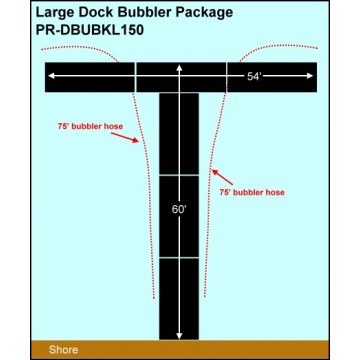
opening under the entire dock structure. When using diffuser lines to protect your dock from ice damage there will be some fairly common installation procedures: place the air compressor in a ventilated cabinet or shed. Some turnkey deicer systems come standard with a lockable cabinet designed to resist salt water and rust but some cheap deicers or homemade deicers do not include or even mention the need for a protective housing for the compressor. In our northern climates where winter temperatures near the Great Lakes can be a bone chilling minus 30 degrees for weeks on end it is essential to protect the compressor. I have seen some inexpensive dock Bubblers that appeal to the do it yourself deicer types that claim that the compressor can sit on the dock without worry but that is a recipe for disaster! The compressor could be damaged by severe weather or in the case of a power failure could be destroyed by the freezing of any condensation in the compressor housing so don't be fooled into thinking a small dock can use a small linear air pump that sits on the end of the dock. From the blower or air pump a weighted line runs into the water. The line can be buried but if you are using a thick walled and high bore airline you can often get away with surface layout. At the end of your airline you attach the diffuser line, de-icing hose or bubbler line or diffuser line which typically runs the length of the dock in need of protection. I sometimes recommend running multiple lines of tubing or a perimeter loop depending on the layout of the boathouse and boat slips involved. Remember that variations in depth can affect the bubble flow of the diffuser tubing so it is better to use multiple lines if there are major deviations in depth around the marine or private dock. Sometimes even a variation of a few feet can inhibit the correct flow of air in a tubing. Since one PSI is equivalent to 2.3 feet of depth a difference of few feet could mean that air flow in the weighted tubing is restricted in the deeper areas and no bubbles are being released. I have seen dock bubbler systems that include single lengths of tubing meant to be placed in a loop of over 400 feet and I have often seen large areas with no bubbles in such installations especially when undersized linear compressors are used. The temptation to buy a cheap bubbler are everywhere on the Internet but it is important to understand the limitations of the technology before leaning towards buying the cheapest system. Of course, in larger marina projects, where hundreds of boat slips are involved and the dock structure is hundreds of feet of complex maze-like boat stalls a larger, more professional grade system is required. In projects like these we will install large high pressure, high CFM compressors to feed multiple lengths of 1/2 inch or 3/4 inch diffuser tubing. 3 HP to 5 HP compressor are not uncommon using a series of control manifold valves to control the airflow into multiple lines of diffuser bubbler hose. Regardless of the system you choose it is wise to control the operation of the dock deicer or dock bubbler with a thermostat control that will only initiate operation of the motor when freezing temperatures warrant operation: usually when the air temperature is gist below the freezing threshold. These inexpensive thermostats measure the outside air temperature and engage the air compressor or submersed thruster only when it is required. Another benefit of using a thermo control unit are the savings in electricity costs associated with the deicer. Building your own deicer, do it yourself dock Bubblers Send us an email describing your dock, marina or boathouse and our design team will submit an affordable bubbler plan or deicing strategy or take a look at our dock bubbler packages Saving money is something most of us want to do and when confronted with the cost of a commercial de-icer I often hear people ask how they can build a cheap deicer or as me how to build a dock bubbler. It can be done but before you consider taking on the task ask yourself if it is really worth the time and effort to buy the parts required and, of course, the actual labor it entails to build a pond bubbler.
If you are gung-ho about doing it yourself it is really not rocket science! Building a dock bubbler involves buying a cheap pump, adding some airline, and then adding a diffuser hose or even diffuser discs at strategic points under the dock or boat slips. I've seen small deicers built for less than $600 dollars but I've also seen such systems fail due to poor design and costly boat and major dock repairs resulting! Using standard PVC plumbing pipes and drilling holes with a hand drill is one way to avoid buying professional grade diffuser tubing but one errant drilling of a hole can result in catastrophic failure of the system. Pumping air through an open ended pipe, creating large coarse bubbles, will work to an extent but often the results are hit and miss. Today's systems have undergone years of testing and while the temptation is often there to build a homemade bubbler is often nagging at our thrifty instinct I have seen such desires lead to more expenses that would have been involved in buying a dock bubbler from a reputable and experienced supply store. Buying
a dock bubbler or a de-icer
Shallow
Dock Bubbler Systems
Dock Bubbler & De-Icer Product & Website Reviews We've seen all manner of websites and products and here are some reviews of popular products and websites from companies you have likely heard of. All website reviews are based on our reviewers experience with the websites being reviewed that offer Bubblers or deicers and their overall knowledge of deicer systems and should be considered as opinions and not scientific or even valid. May the buyer beware in all cases and ask questions before you buy.
Kasco Marine,
Inc. De-Icers
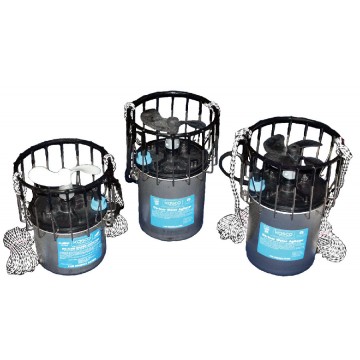
They have dealers throughout North America and our review panel found it easy to contact them to find a reliable dealer in any area in Canada or the United States. No pricing, typical of a manufacturers website, but overall it instilled confidence in our test subjects. Kasco Deicers are available pretty much everywhere from Ebay to just about every mom-and-pop website on the web. A little digging by the consumer can find some incredibly low prices on these systems. Make sure you purchase from a reputable company so you will have after sales service in the event of warranty issues or problems with your deicer. From the website: http://www.de-icer.com/ "Kasco De-Icers have been trusted to protect property and equipment for over 40 years. Kasco De-Icers have been proven to prevent ice formation around docks, boats, equipment, etc. from areas with minimal ice formation to over 300 miles north of the Arctic Circle. You can rest assured, your Kasco Marine De-Icer will protect your property during the harsh winter months. Kasco De-Icers are also used during non-winter months for improved water quality and water movement. Kasco De-Icers can eliminate stagnant water areas and keep trash and debris from entering your marina, boat house, or dock area. Use your Kasco De-Icer year round for improved water quality during summer months and for preventing ice damage during the winter months." Amazon Affiliate Kasaco Link: Special pricing on Kasco deicers at Amazon Ice Eater 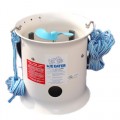 The
range of websites offering the ice eater shows that it is a popular
low-cost deicer system and our review team was quite impressed by
the construction presentation of the ice eater system. The
range of websites offering the ice eater shows that it is a popular
low-cost deicer system and our review team was quite impressed by
the construction presentation of the ice eater system. Bearon (formerly IceEaters were made by The Power House, Inc). uses only the finest materials in our patented product. By example, the end bell is made of solid brass, our housings are stainless, and the venturi shroud, which not only directs water flow, but protects the unit if it's dropped is made from schedule 40 PVC. The Ice Eater is actually more efficient to operate than Kasco. The Bearon Ice Eater can clear a larger area than Kasco hp. for hp. The units don't require a dock mount, a cost saving feature. The material used in these products are superior to many other vertical lift unit. They one of have the best warranty return histories in the industry with some units still in operation after 20 years of use (i.e.. Cutter Marine in Maryland). They have established over the last 28 years a strong dealer-distributor network throughout North America. More info
"Ice Eater's 3/4HP Ice Eater propeller draws up warmer subsurface water and deflects it to the surface creating a constant circulation of warmer water that prevents ice formation. Ice Eater will melt existing ice. Unlike other de-icing units, Ice Eater requires no additional hardware in order to obtain the desired deicing pattern. Ice Eater is shipped complete with suspension lines. It can be taken out of the box, hung in place and plugged in. Ice Eater may be hung from a pier or boat. Two to three feet is the average operating depth. For optimal use and placement contact your Local Ice Eater Distributor by clicking the link above. DESIGN FEATURES: The design of the Ice Eater's venturi shroud (housing) with outwardly flared ends draws warmer water from greater depths than other conventional de-icers. The shroud is submersible below the surface either vertically or angled from vertical. A set of mounting holes at opposed positions on the flange allows the lines to be attached." Dock Bubbler It
appears that the dockbubbler.com website is offline and they are
no longer in business. Dock
De-Icer From
the website: http://www.arbrux.com 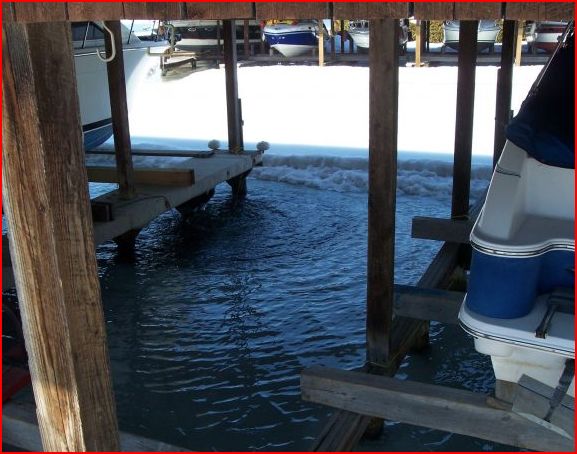 The
ice-away product is along the same lines as the ice eater and the
Kasco systems. Another variation which left our reviewers looking
at a few Canadian websites that did seem to specialize in Canadian
deicing companies. The product itself left some of our test subjects
a bit unimpressed but the price points were good and the websites
offering the product seemed to be specialists in dock care so they
did receive a good rating. The
ice-away product is along the same lines as the ice eater and the
Kasco systems. Another variation which left our reviewers looking
at a few Canadian websites that did seem to specialize in Canadian
deicing companies. The product itself left some of our test subjects
a bit unimpressed but the price points were good and the websites
offering the product seemed to be specialists in dock care so they
did receive a good rating.Arbrux Deicers from Arbrux Limited are a manufacturer of De-Icers in Canada. The Arbrux de-Icers are more expensive than Kasco units but they are still known for its reliability and efficiency. The De-Icer brings the warmer, deeper water from the bottom of a body of water to the surface to create open water by utilizing a propeller to move the water at a rate of 500 gallons per minute. The ½ HP De-Icer will generally keep a 40’ diameter circle open when the unit is placed 5’ below the surface of the water. Positioning of the De-Icer depends on the area/structure being protected. A De-Icer installed in a sling mount formation is ideal for boats and boat houses. When slung between two mooring points, the De-Icer has less potential to oscillate. For areas with one mounting point, the De-Icer should be hung by a single chain. A float mount is also available for Deicers that are being used in areas without a mounting point available. For Installation after freeze up, the De-Icer can be installed through a hole that has been augured in the ice. This is convenient for mid winter installations. The De-Icer comes standard with hooks and ropes for hanging. The use of a Franklin, stainless steel, water cooled and water lubricated motor eliminates the concern for oil leakage into the water while allowing for a maintenance free product. Their specially designed propeller and drive structure (both made from reinforced Zytel) create a high water flow while protecting the propeller and power cord from damage. Arbrux Deicers are fully ETL approved. They meet UL and CSA standards for safety. Arbrux Limited’s Deicers come standard with 1/2hp, 120V Stainless Steel Submersible Motors and either 7.5m (25’) or 15m (50’) power cables. Other voltages, Hp and cable lengths are available. From the website: 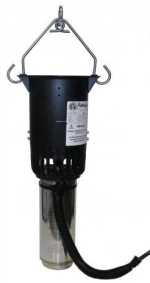 "ICE-AWAY's high speed motor-driven propeller brings the warmer deep water
to the surface. It is diffused upward and outward into a circular
area equivalent to approximately 8 feet in diameter - for every foot
of propeller depth! A 1/2 HP ICE-AWAY with a 25' cord placed at 5
feet of depth will- in most cases keep a 40 foot circle of water ice-free
during the winter months. There are optional cord lengths and HP models.
The price of a 1/2 HP ICE-AWAY unit with a 25' power cord is $689.95
plus GST and PST. To ensure proper operation, these units should be
monitored during the winter months. Changing water levels in the lakes
could expose the de-icer unit and result in a burned out motor. De-Icer
units need to be kept at proper depth for maximum performance. Power
outages that drop breakers will need to be turned back on, to restart
the de-icer. Nothing should be left unattended for a long period of
time. " "ICE-AWAY's high speed motor-driven propeller brings the warmer deep water
to the surface. It is diffused upward and outward into a circular
area equivalent to approximately 8 feet in diameter - for every foot
of propeller depth! A 1/2 HP ICE-AWAY with a 25' cord placed at 5
feet of depth will- in most cases keep a 40 foot circle of water ice-free
during the winter months. There are optional cord lengths and HP models.
The price of a 1/2 HP ICE-AWAY unit with a 25' power cord is $689.95
plus GST and PST. To ensure proper operation, these units should be
monitored during the winter months. Changing water levels in the lakes
could expose the de-icer unit and result in a burned out motor. De-Icer
units need to be kept at proper depth for maximum performance. Power
outages that drop breakers will need to be turned back on, to restart
the de-icer. Nothing should be left unattended for a long period of
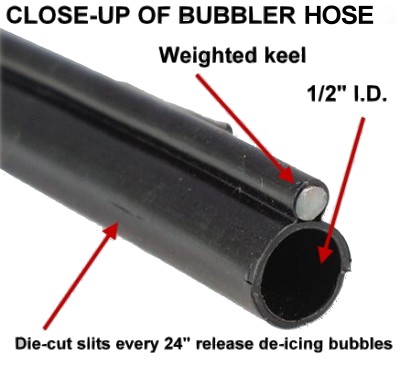
time. "A clear and concise website offering unique systems and custom designed dock protection systems. Good supply of information and our review teams found the information was presented in a professional manner. Large and small systems were presented with examples of how they would personalize a system based on client needs. Large scale de-icing and industrial aeration systems are their specialty. Also an authorized Canadian Kasco Dealer. From the website: Using diffuser line, de-icing hose or bubbler line to Keep your dock free from ice We recommend two different types of systems to prevent ice from forming around a dock a "dock bubbler" type or a submersed motor type; one uses a length or several lengths of air diffusing diffuser line, de-icing hose or bubbler line under or around the dock to circulate the deeper warmer water. A low cost compressor on the dock or nearby feeds air to a length of diffuser line and the rising boil of active bubbles bring warm water to the surface where it keeps ice from forming. Even a small linear compressor, which consume very little electricity, can produce enough air to create an active circulating movement under your dock due to the low operating pressure of our new air diffusion tubing.
The pond report also has information on: | ||||||||||||||||||||||||||||||||||||||

 Our
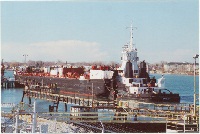
deicing experts have years of experience with design and installation
of bubblers and de-icers in mining, stormwater, gas and oilsands
and tailings ponds, ski hills, municipal docks and marinas
and dam deicing and pumphouse deicing.
Our
deicing experts have years of experience with design and installation
of bubblers and de-icers in mining, stormwater, gas and oilsands
and tailings ponds, ski hills, municipal docks and marinas
and dam deicing and pumphouse deicing. 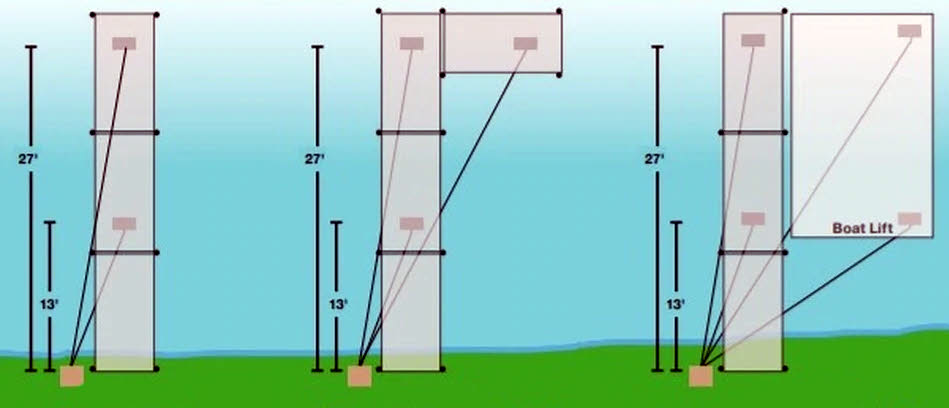
 Lake
and Pond
Lake
and Pond  Earth
Ponds
Earth
Ponds Diet
for a Small Lake
Diet
for a Small Lake Managing
Lakes and Reservoirs
Managing
Lakes and Reservoirs