Duckweed
Control
Duckweed
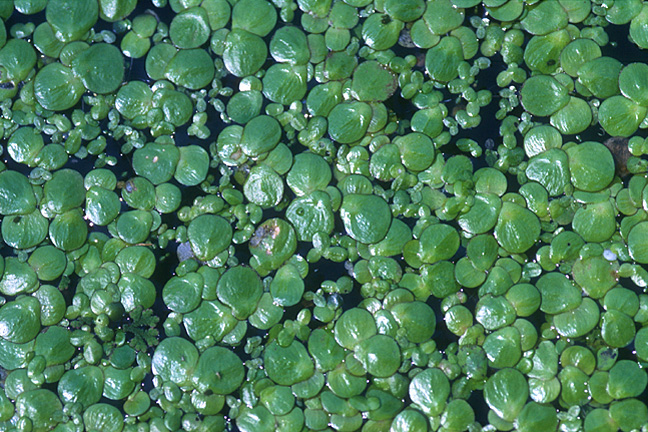
is an agressive pond weed that covers a pond quickly with a green
scum.
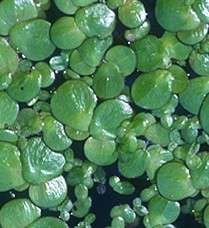 Duckweed
(Lemnaoideae) is something I am actually very fond of...of course
when a large pond is infested with this plant it is no fun but in
smaller water gardens and backyard ponds duckweed can actually be
a helpfull addition to the ecosystem! Duckweed
(Lemnaoideae) is something I am actually very fond of...of course
when a large pond is infested with this plant it is no fun but in
smaller water gardens and backyard ponds duckweed can actually be
a helpfull addition to the ecosystem!
Myself, I've
actually gone to the garden store and bought a container full of
duckweed to add to my backyard pond...it cost me $5 and my wife
asked me if I was losing my marbles because duckweed can be found
in almost any farm dugout or stagnant swamp in the area!
I am asked at least twice a week about methods for controlling duckweed
and other aquatic plants and algae of course.
In a large pond duckweed can be an invasive plant that can cover
the surface quickly and it often is a real nuisance for the pond
owner who suddenly can't see anything in the pond!
Before we kill the duckweed with an aquatic herbacide, yes there
are some good algaecides that can eliminate duckweed from a pond,
lets make sure we actually do want to do it because this floating
plant is actually a real wonder of the pond!
Duckweed can absorb a whole bunch of nutrients from the water and
will provide a great umbrella of shade for fish...so it will keep
waters cooler and also suck out phosphates from the pond. These
phosphates and other nutrients are the junk in the pond that cause
the big blooms of floating green algae and algae that grows on the
bottom of the pond.
Why
You May Love Duckweed:
Duckweed is
a small delicate plant that drifts on the pond surface, filling
in spaces between the lily pads, creating a lovely green blanket
across the pond. This provides a lush habitat for frogs and fish
and insects of the pond.
The layer
of floating aquatic plants provides shade to the pond keeping it
cooler during stifling hot days of overhead sun. Waterfowl will
feed voraciously on the duckweed thus nest nearby and live in the
pond.
Duckweed grows rapidly and absorbs mineral elements like nitrogen
and phosphates from the water column so it can be an important part
in the aquatic rehabilitation of any pond or lake as these nutrients
can cause problems like algae and cyanobacteria. It is especially
good at removing ammonia from ponds.
Beyond providing shade for fry bluegill and a place to live for
bullfrogs the duckweed helps reduce evaporation which can be a problem
in a clear pond without any cover to slow the rate of pond evaporation.
Sometimes just the rich green color of the plant alone is enough
to make us feel like our pond is a healthy and natural aquatic system!
A bit like a stained glass window on the pond, duckweed is a wonderful
and beautiful plant, that with a bit of understanding and acceptance
is actually a very beautiful thing!
Why You May Hate Duckweed:
Duckweed is an invasive and agressive aquatic weed that can rapidly
multiply and if conditions are right will completely cover a pond
with a thick green cover of tiny green plants that are only a few
milimeters in size.
The thick matting of pond weed can literally choke out a pond and
if conditions, temperatures and nutrient levels are right can completely
hide the water and create a cover that hides the pond and makes
it almost unpleasant. Frogs and ducks and turtles will live in what
looks like a swamp! Maybe it provides food for swans and geese and
a mallard duck or two but it can choke out oxygen levels.
Two Ways of Getting Rid of Duckweed
Well, actually you could just ignore the duckweed and live with
the problem! So that means there are three options for this aquatic
plant. Adding natural bacteria to control muck and nutrients will
assist in slowly reducing the amount of food available for this
aquatic floating bugger. The beneficial bacteria, over time, will
have an impact on the amount of duckweed in your pond...but it can
be a long process and manual removal will greatly help this process.
So basicially, beyond ignoring it you have two ways to deal with
duckweed:
1
- The Chemical Way
Clipper®
Aquatic Herbicide
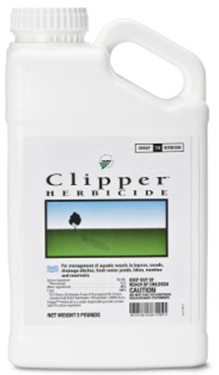 Clipper
is a new Aquatic Herbicide that is completely safe for use in lakes
and ponds. Clipper Aquatic Herbicide selectively controls a number
of invasive and nuisance aquatic plants, including submersed plants
such as hydrilla, Eurasian watermilfoil, curlyleaf pondweed and
cabomba as well as floating plants such as duckweed, giant salvinia,
water lettuce and watermeal. The active ingredient in Clipper is
51% Flumioxazin, which works swiftly and then dissipates quickly
from the water column and does not accumulate in sediment. Clipper
is a water soluble granular product that is easy to apply, mix,
and handle and offers reduced PPE requirements. Clipper
is a new Aquatic Herbicide that is completely safe for use in lakes
and ponds. Clipper Aquatic Herbicide selectively controls a number
of invasive and nuisance aquatic plants, including submersed plants
such as hydrilla, Eurasian watermilfoil, curlyleaf pondweed and
cabomba as well as floating plants such as duckweed, giant salvinia,
water lettuce and watermeal. The active ingredient in Clipper is
51% Flumioxazin, which works swiftly and then dissipates quickly
from the water column and does not accumulate in sediment. Clipper
is a water soluble granular product that is easy to apply, mix,
and handle and offers reduced PPE requirements.
CONTROLS
Alligator Weed Alternanthera philoxeroides
Frog’s-bit
Limnobium spongia
Water
Fern Salvinia spp.
Water
Lettuce Pistia stratiotes
Water
Pennywort Hydrocotyle spp.
Filamentous
algae Pithophora
Filamentous
algae Cladophora
For application only to non-flowing canal water that will not be
released for irrigation until 5 days after application. Application
of Clipper Herbicide to public aquatic areas may require special
approval and/or permits. Consult with local state agencies, if required.
Sonar®
Aquatic Herbicide
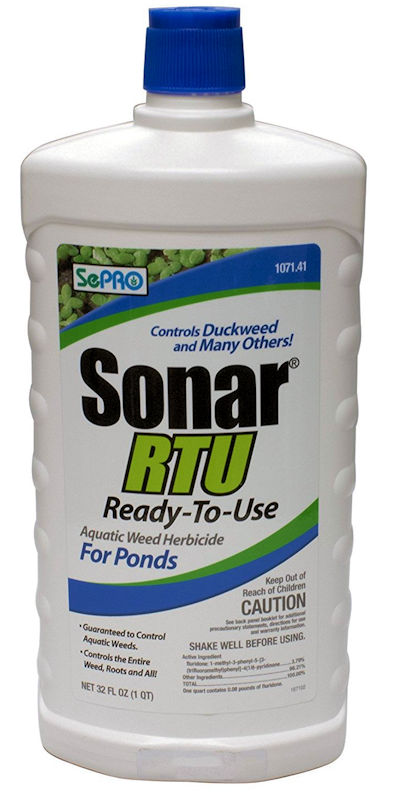
Sonar ready-to-use RTU represents an exciting new era
in pond weed management for the do-it-yourselfer the innovative new
RTU formulation allows anyone to make water usable for recreation,
bring fish populations back into balance and restore property values.
We're so sure that applications of sonar RTU conducted according to
directions will control target aquatic vegetation listed on the label
that we'll work with you until you see the results you expect.
There's never been a better time to trust your lake or pond to sonar.
Sonar RTU and duckweed many pond owners consider duckweed to be their
toughest aquatic weed problem. Duckweed is a very comma on nuisance
aquatic weed that is spread from pond to pond via waterfowl or other
wildlife.
While it is comma only mistaken for algae, duckweed is actually a
tiny plant with an explosive reproductive capacity that can completely
cover a pond in just a few weeks to the point that the infested waterbody
resembles a golf-course green.
Fortunately, no other aquatic herbicide is more effective on duckweed.
Sonar provides complete, long-lasting control of duckweed and other
stubborn unwanted aquatic vegetation.
Aquatic herbicides and pond weed killers
Aquatic algaecides and herbicides are very effective at controlling
duckweeds and other unwanted invasive pond species. You should understand
that such algae problems, well...it's not reaslly an algae but an
aquatic weed plant, if they are treated with herbiceds can lead to
a dependance or resistance and scientists generally agree that chemical
selection pressure that is applied applied to aquatic weed populations
for a long enough period of time eventually leads to resistance. This
means that while the chemical pond weed killer may work quickly and
effectively for the first few years, unless you are adding a positive
treatment with aeration and natural beneficial bacteria you will just
be "chasing the dragon" so to speak!
2
- The Natural Way
Natural
bacteria for ponds
If the pond is small enough just the best way to remove the small
little flowering plant known as duckweed is to use a fine meshed
net and just manually remove it day by day, hour after hour, until
there is none left. Of course it is really tough to completey eradicate
the problem but you can keep it under control just like keeping
the dandelions out of the vegetable garden!
You need a net with a long handle or a good quality aquatic rake
to harvest this pond weed if you want to deal with this problem
naturally or of course you can invite a family of ducks or geese
or swans into your pond and they will love the free food supply
offered by these floating flowering plants but you will still need
the manual removal...if you don't want to accept the duckweed or
don't want to perform the manual work or invite the Duckworth family
into the pond then you need to go to the next option..
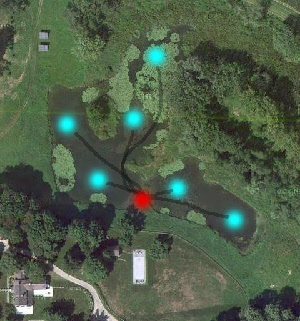 Simply
put, adding aeration to a pond, water-garden or even a natural
lake is one of the best methods to control algae and maintain
clear waters and discourage the build-up of bottom sediments. Simply
put, adding aeration to a pond, water-garden or even a natural
lake is one of the best methods to control algae and maintain
clear waters and discourage the build-up of bottom sediments.
It is extremely important never to overlook aeration when building
a new pond or when trying to restore one that is undergoing
eutrophication especially in small basins athat have a large
organic load and that are typically mucky at the bottom. The
organic material can be grass clippings, so it is best to leave
a perimiter of natural thick vegetation and even aquatic plants
to help reduce erosion and prevent runoff laced with fertilizers
from getting into the water.
Our experience has shown that in most cases that adding air
diffusion into the bottom levels of the pond is often the the
best form of aeration.
This manner of aerating is basically the injection of air bubbles
into the water to supply oxygen as well to create water movement
because as the small air bubbles rise to the surface they create
a movement that pulls oxygen deprived waters from the depths
up towards the surface where they can interact with the atmosphere
and achieve a high level of efficient oxygen transfer.
Solar
Aeration Systems | Build
Your Own Aeration System | Complete
Aeration Systems
Our
Favorite Amazon Aeration Products
As an Amazon affiliate we may recieve payment for
purchases made through Amazon. |
WhiteCap®
selective herbicide
|
Average
Water Depth of Treatment in Feet
|
Fluid
ounces per acre
to achieve desired herbicide concentration
|
Application
Directions
|
|
45
ppb
|
90
ppb
|
|
1
|
3.8
oz.
|
7.7
oz.
|
ApplyWhiteCap
to the entire surface area of the pond.
Single Applications: Use the amount of WhiteCap
listed to give 45 to 90 ppb .fluridone in treated water.
Higher rates should be used for dense weed infestations,
for dif.cult-to-control species, and for smaller ponds
(less than 5 acres in size and average water depths of
less than 4 feet). Split or Multiple applications:
Use when dilution of the treated water is likely to occur.
Do not exceed 90 ppb per annual growth cycle. |
|
2
|
7.7
oz.
|
15.7
oz
|
|
3
|
11.8
oz.
|
23.4
oz.
|
|
4
|
15.7
oz.
|
31.4
oz.
|
|
5
|
19.5
oz.
|
35.0
oz.
|
|
6
|
23.4
oz
|
46.7
oz.
|
|
7
|
27.2
oz.
|
54.4
oz.
|
|
8
|
31.4
oz.
|
62.4
oz.
|
|
9
|
35.2
oz.
|
70.1
oz.
|
|
10
|
39.0
oz.
|
78.1
oz.
|
|
|
Vascular
Aquatic Plants Controlled by WhiteCap
|
|
Floating
Plants
|
Emersed
Plants
|
Submersed
Plants
|
Shoreline
Grasses
|
|
common
duckweed
(Lemna minor)
|
spatterdock
(Nuphar luteum)
|
bladderwort
(Utricularia spp.)
|
paragrass
(Urochloa mutica)
|
|
|
water-lily
(Nymphaea spp)
|
common
coontail
(Ceratophyllum demersum)
|
|
|
|
common
elodea
(Elodea canadensis)
|
|
egeria,
Brazilian elodea
(Egeria densa)
|
|
fanwort,
cabomba
(Cabomba caroliniana)
|
|
hydrilla
(Hydrilla verticillata)
|
|
naiad
(Najas spp.)
|
|
pondweed
(Potamogeton spp., except Illinois pondweed)
|
|
watermilfoil
(Myriophyllum spp., except variable-leaf milfoil)
|
|
White Cap Selective Herbicide Control aquatic weeds and grasses in fresh
water ponds, lakes, and drainage/irrigation canals with WhiteCap™
SC selective herbicide, a proven reformulation of the popular active
ingredient fluridone. WhiteCap effectively controls a wide range
of floating, submersed and emersed aquatic vegetation, including
Duckweed, Hydrilla, Bladderwort, Watermilfoil, Naiad, Elodea,
Water-lily, Pondweed, and Coontail
See
The List of Aquatic Weeds that White Cap SC will control before
you buy. Email us if you're not sure.
Susceptible
aquatic weeds absorb WhiteCap SC through the shoots and roots. For
effective control, contact of WhiteCap with the target plant must
be maintained for at least 45 days. Effective control is reduced
if conditions exist that dilute the concentration of WhiteCap in
the water to below labeled rates.
Apply WhiteCap as a surface spray or subsurface injection at rates
between 10 and 90 ppb for single applications, or if multiple applications
are made, do not exceed 150 ppb per growing season.
Water treated with WhiteCap SC at rates greater than 5 ppb must
not be used for irrigation of certain crops and newly seeded turf.
If the concentration of WhiteCap is less than 10 ppb, established
tree crops, established row crops or turf can be irrigated with
WhiteCap treated water.
Do not apply WhiteCap at rates greater than 20 ppb within ¼ mile
of any functioning potable water intake.
WhiteCap effectively controls a wide range of floating, submersed
and emersed aquatic vegetation, including Hydrilla, Bladderwort,
Watermilfoil, Naiad, Elodea, Water-lily, Pondweed, Coontail and
Duckweed. Selective control.
At low use rates, it is safe for most native beneficial aquatic
plants; WhiteCap SC selectively removes the nuisance plants, while
having little impact to desirable species. Low
use rates provide for cost-effective aquatic plant control.
Complete control.
Readily moves and disperses throughout the water column, providing
complete and thorough control of target nuisance aquatic weeds Slow
control. Works slowly to remove excessive aquatic weeds with minimal
impact to aquatic ecosystems No human or livestock use restrictions.
Water treated is potable water safe and may be used immediately
for human recreation and for watering livestock.
Suggested bApplication Rates For Duckweed
75' x 75' Pond (.13) Acre 4 ft avg depth. - Amount required: 2 -
4 ounces
105' x 105' Pond (.25) Acre 4 ft avg depth. - Amount required: 4
- 8 ounces
148' x 148' Pond (.50) Acre 4 ft avg depth. - Amount required: 8
- 16 ounces
208' x 208' Pond (1.0) Acre 4 ft avg depth - Amount required: 16
- 32 ounces
Duckweed
Information Websites
Here
are some websites we recommend if you are looking for more information.
Washington State Department of Ecology
https://www.ecy.wa.gov/Programs/wq/plants/pla
ntid2/descriptions/lemmin.html
Lemna minor (lesser duckweed) and Lemna trisulca (star duckweed) Duckweeds
are among the world's smallest flowering plants. Individual lesser
duckweed plants are tiny, round, bright green disks, each with a single
root.
USDA.gov
https://plants.usda.gov/java/profile?symbol=LEVA
PLANTS Profile for Lemna valdiviana (valdivia duckweed) | USDA PLANTSA
PLANTS profile of Lemna valdiviana (valdivia duckweed) from the USDA
PLANTS database.: Kingdom Plantae – Plants Subkingdom Tracheobionta
– Vascular plants Superdivision Spermatophyta – Seed plants Division
Magnoliophyta – Flowering plants Class Liliopsida – Monocotyledons
Subclass Arecidae Order Arales Family Lemnaceae – Duckweed family
Genus Lemna L. – duckweed Species Lemna valdiviana Phil. – valdivia
duckweed
Wikipedia
https://en.wikipedia.org/wiki/Lemnaoideae
Lemnaoideae - Wikipedia, the free encyclopedia 24 May 2009 ... Duckweed
is an important food source for waterfowl and are eaten by humans
in ... Classification of the duckweeds in the family Lemnaceae is
... en.wikipedia.org/wiki/Lemnaoideae - Cached - Similar - Lemna -
Wikipedia, the free encyclopediaLemna is a genus of free-floating
aquatic plants from the duckweed family. .... Lemna Ecotox testing
Duckweed growth inhibition tests and standardisation ...
Guppies.com
https://www.guppies.com/forums/showthread.php/duckweed-and-waterquality-18686.html
Duckweed and waterquality... a blessing in disguise. In fact, duckweed
does much more than suck up every particle of Nitrate in your tank.
In depth study will reveal that duckweed attacks ammonia vigorously,
as well as Nitrates, Nitrites and just about any other molecule with
the nitrogen atom in it, lol. In addition to that, duckweed sucks
up phosphorus like a thin milkshake, actually removes suspended solids,
and organic material and even other toxins!. As if that weren't impressive
enough, it produces oxygen like nobodies business!
Homemade Duckweed Skimmer
https://forums.pondboss.com/
If you are looking for a homemade duckweed skimmer then we saw on
the PondBoss Forums of a fellow who used a "prickly rope"
that he rigged up using a simple nylon rope and zip-ties to create
an ingenious pond skimmer system that basically corrals the duckweed
and traps it in the circle of the "prickly rope" where it
can be easily removed. You have to see it to believe it and I bet
it works too!
Email us for information
or with your questions.
 Pond
Report Store Pond
Report Store
The
pond report also has information on:
Algaecides
& Bacteria | Deicers
& Bubblers | Weed
Removal | Liquid
Bacteria | Pond
Pumps & Fountains | Aeration
| Winter
Pond Care | Algae
Control | Pond
Liner | Muck Pellets |
Build
a Solar Aerator | Rotary
Vane Compressors | Floating
Fountains
| Building
a Pond | Linear
Air Compressors & Pumps | Weighted
Airline | Diffusers
& Airstones | Solar
Aeration Systems | DC
& Battery Operated Pumps | Windmill
Aeration | Dock
Bubbler Packages | Building
a Waterfall |
Dyes & Colorants | Consultations
| Questions &
Answers
| Links
& Resources | Eurasian
Milfoil
| |
Mosquito Control | Pondkeeper
Treatments | Aeration
Systems | Septic
Bacteria | Grease
Trap Blocks |
Compost Aeration | Dissolved
Oxygen Meters | SOTR
& Pumping Rates |
Portable
Generators |
Duckweed
Control |
Pond
Plans & Pond Building Books & Guides |
© 2007
- 2024 The Pond Report
about
us | privacy
policy | contact
us
|

 Duckweed
(Lemnaoideae) is something I am actually very fond of...of course
when a large pond is infested with this plant it is no fun but in
smaller water gardens and backyard ponds duckweed can actually be
a helpfull addition to the ecosystem!
Duckweed
(Lemnaoideae) is something I am actually very fond of...of course
when a large pond is infested with this plant it is no fun but in
smaller water gardens and backyard ponds duckweed can actually be
a helpfull addition to the ecosystem!